
The way organisations think about leadership is changing. Fractional and interim models were once treated as stopgap measures; however, they are now a deliberate part of how smart organisations access senior capability, navigate change, and lift business capability and performance.
The shift reflects an evolving truth about building business capability: not every business need requires a permanent hire. Sometimes what you need is the right leader, for the right period, with the experience to make an immediate difference.
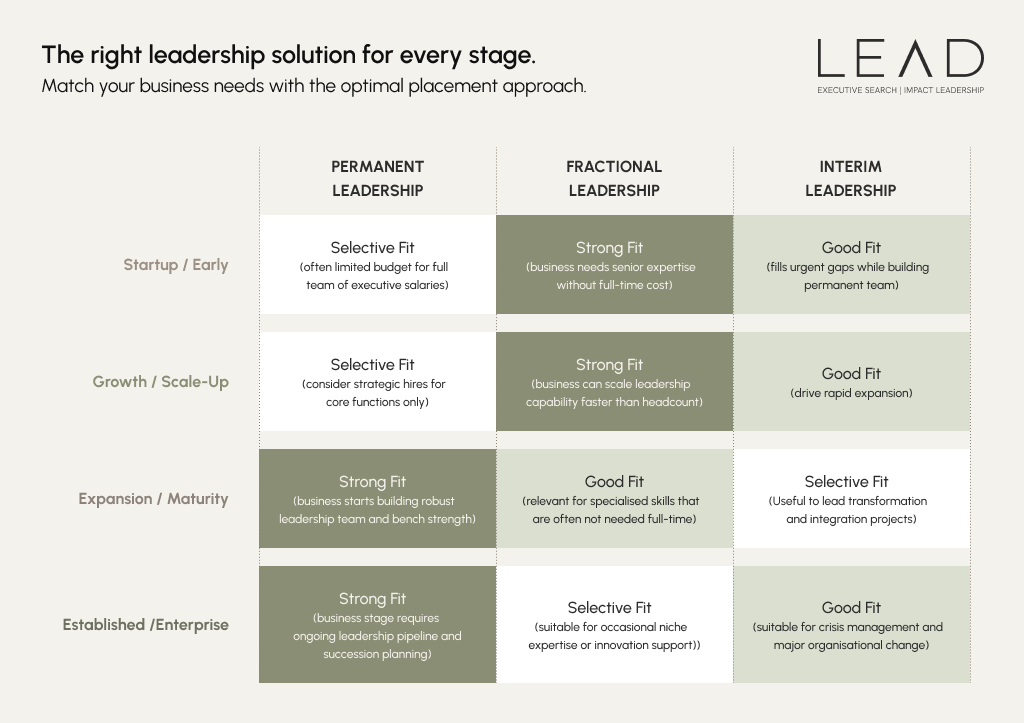
Below is the leadership framework we use regularly with our clients. It maps how permanent, fractional and interim leadership tend to work together across the stages of a business lifecycle, and where each model adds the most value.
Startup & early stage: getting the fundamentals right.
Early-stage organisations face a common tension: the need for experienced leadership is real, but the budget and scale to build a full executive team often isn’t there. Leadership decisions at this stage are about establishing direction and ownership without overcomplicating the structure or burning through cash runway.
Permanent leadership
Selective. Focus on the foundational roles that require full-time commitment and genuine ownership of the business direction.
Fractional leadership
A strong fit. Senior expertise without the overhead of a permanent hire. Common examples for this stage of business growth includes:
- A fractional CFO to build financial discipline and prepare for investor conversations
- A fractional Head of People to shape early culture and hiring frameworks
- A fractional Marketing leader to develop brand positioning and go-to-market strategy
Interim leadership
Well suited to urgent gaps and immediate challenges – situations where you need someone capable to step in quickly. This might include an interim operations leader to stabilise delivery, a finance lead during a funding round, or a programme lead to get a critical initiative off the ground.
Growth & scale-up: maintaining momentum.
As organisations move into growth mode, leadership demands increase quickly. Teams expand, expectations rise, and the pace of change accelerates. The risk at this stage isn’t just missing targets, it’s making rushed appointments that create problems down the track. Flexibility remains a genuine advantage at this stage of business growth.
Permanent leadership
Increasingly important. Key permanent appointments at this stage (such as a CFO, COO or Head of Sales) provide the stability and governance structures that sustainable growth requires.
Fractional leadership
A strong fit, particularly where specialist expertise is needed to support scale. Common examples include:
- Fractional people leaders managing rapid hiring and capability development
- Fractional digital or transformation leaders supporting system and process change
- Fractional marketing leaders to develop brand and go-to-market execution
Interim leadership
Frequently used during periods of rapid expansion or significant transition e.g. an interim COO to stabilise operations, a transformation leader to deliver major change, or an executive covering a gap while the organisation takes the time to make the right permanent appointment.
Expansion & maturity: building for depth and longevity.
As organisations mature, leadership structures become more defined and building long-term capability becomes a priority. Decisions at this stage are less about filling gaps and more about ensuring the right people are in place for the next phase of growth or complexity.
Permanent leadership
A strong fit and the foundation of leadership strategy. Roles such as CEO, CFO, Head of People & Culture and other key functional heads are typically permanent appointments, providing continuity and strategic alignment across the business.
Fractional leadership
A good fit for specialist expertise that isn’t required full-time: sustainability leaders, technology or cyber specialists, or experienced change leaders supporting specific initiatives without expanding the permanent headcount.
Interim leadership
Selectively used to lead defined periods of transformation or transition, including integration projects, mergers and acquisitions, or stepping in during executive turnover to maintain stability while longer-term decisions are made.
Established & enterprise: resilience, succession and managing risk.
As businesses become more established, the leadership agenda shifts toward further capability build, long-term resilience, succession planning and managing risk while continuing to evolve the business model.
Permanent leadership
Central to long-term strategy, culture and succession. Large organisations rely on permanent executive teams to provide consistency, accountability and leadership continuity across more complex operating models.
Fractional leadership
Used selectively for niche expertise or independent perspectives e.g. fractional innovation leaders, digital specialists or advisors supporting specific strategic priorities without the need for full-time appointments.
Interim leadership
Remains highly relevant, particularly during disruption or major organisational change – crisis leadership, turnaround situations, large-scale transformations or leadership transitions where experienced judgement is needed quickly.
Fractional leadership in action – Case study.
Understanding how these models work in theory is one thing. Seeing them work in practice is another.
Below is a recent case study where we placed a Fractional CMO in a growing New Zealand business with a founder-CEO to support the company’s required evolution strategy.
The founder was stretched across sales, marketing, business strategy and team building – all critical areas, but none getting the focused attention they needed. A full-time C-suite hire at $250K+ wasn’t the right move at that stage of the business. We matched them with a Fractional CMO who integrated into the business two days per week.
The results were significant:
- $150K+ saved compared to a permanent hire, while accessing the same level of strategic expertise
- $200K in additional savings identified through a strategic review of marketing spend and operational processes
- A clear marketing strategy was developed that replaced scattered activity with focused, measurable execution
- Business strategy support for the founder, creating clarity on priorities and the next growth phase, including funding requirements
A new marketing and customer experience role was recruited with the CMO’s guidance, reducing direct reporting lines for the CEO and allowing the fractional CMO to lead marketing execution alongside critical strategic work.
One year on, the engagement continues. What started as a flexible arrangement evolved into an ongoing strategic partnership, delivering sustained value at a fraction of the cost of a permanent executive.
“Having senior marketing and strategic expertise embedded in our business (without the overhead of a full-time exec) has been transformative. We got impact from day one and we continue to benefit from that relationship.”
Looking to expand leadership capability?
At LEAD Executive Search, we work closely with organisations navigating complexity, growth and change. We focus on senior leadership appointments where outcomes and cultural alignment matter, supporting organisations to appoint leaders who perform in real-world environments.
Because we’re in continuous conversation with senior leaders across the market, we have current insight and strong relationships with high-potential leaders already in place. We know who the best leaders are and which leaders are right to support your business as it grows. This allows us to move quickly and confidently to identify and appoint leaders whose experience, judgement and approach fit your specific situation.
If you’d like to explore your leadership needs, we’d love to support you. Get in touch with us at [email protected]
For more news and updates, follow us on LinkedIn.